Call Queensland Cork Supplies & Westfloors: 07 3876 4844
Email: westfloors@bigpond.com

About Us
Trusted and Reliable
About Queensland Cork Supplies & Westfloors in Brisbane
Brisbane's Oldest Cork Floor Specialists
Queensland Cork Supplies & Westfloors is proud to be one of the first cork tile flooring experts in Brisbane.
Established in 1966 to fill a need in the local market for quality cork tile flooring installations and have been doing an outstanding job ever since.
Trust our friendly, experienced team to meet your needs.

We Offer Free Quotes on All Our Work
With over five decades of experience in cork flooring installations under our belt, we're confident that we can provide you with quality work at an affordable price. As such, we offer free quotes and never subcontract our jobs; our work is done completely by our own team to ensure that you always get consistently excellent results on your floor.
Our Special Method of Cork Installation
At Queensland Cork Supplies & Westfloors, we want your cork floor to be something you can be proud of. We continue to use our tried and true method of cork tile floor installation. Using the best cork tiles we can access, we lay and then apply 3 coats of suitable, flexible polyurethane to ensure the entire floor is sealed. This coating is able to be recoated in the future with a single coat, without the need for a complete resand.
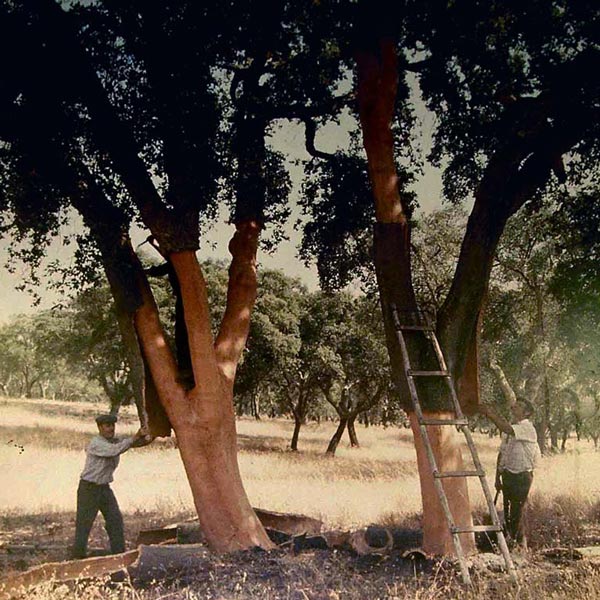
The Cork Oak Tree
Cork is the bark of the Quercus suber, or the cork oak, which is endemic to south west Europe and North West Africa. Portugal produces approximately 50 percent of the world’s cork harvest annually.
Cork has impermeable, buoyant, elastic and fire-retardant properties and is used in a variety of products including wine corks, floor tiles, wall tiles, insulation and pinboards.
Cork is made up of millions of 14 sided cells. The cork industry is regarded as environmentally friendly. Cork production is considered highly sustainable because the cork tree is not cut down to obtain cork, only the bark is stripped, the tree continues to live and grow. It is illegal to cut down a cork tree in Portugal.
Cork is extracted from May to August when the cork can be separated from the tree without causing permanent damage. When trees reached approx. 25 years of age, the bark can be removed for the first time. This first harvest bark is called “virgin” cork. Subsequent harvests usually occur at intervals of nine years.
The skilled workers who remove the cork bark are called extractors and they use a very sharp axe. The cork is then stacked in piles and can be left until picked up as cork is not inclined to rot.
Cork’s structure and natural fire-retardant properties make it suitable for acoustic and thermal insulation in walls, floors and ceilings.
Why Do People Choose Our Team?
"Super friendly and helpful. Lots of advice for DIY." — Anonymous
"Nice people with plenty of friendly customer service" — Wayne B.